Training modules run from Monday 17 June to Thursday 20 June 2024.
Duration of each session is 3 hours, which includes a 30 minute break. [VTC5 is 2 hours, no break]
TBA
Day
Time
Tutor
Affiliation
VTC1: Vacuum - The Basic Principles
Monday
14:00
Dr Stuart Astin
University of Salford
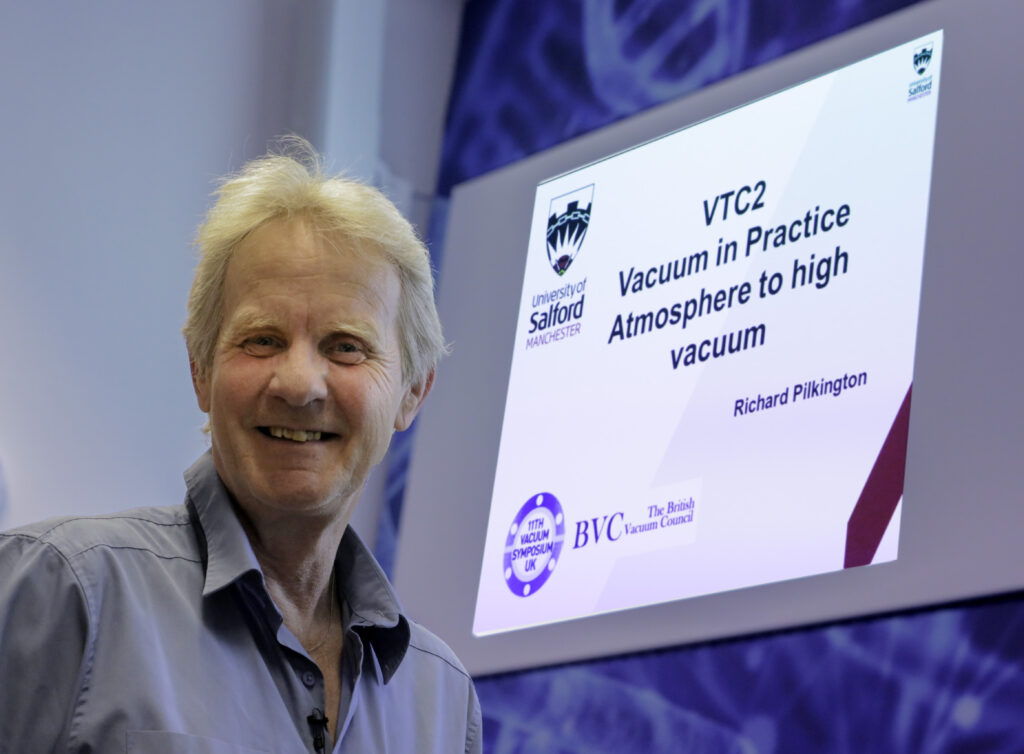
VTC2: Vacuum in Practice - Atmosphere to High Vacuum
Tuesday
14:00
Dr Richard Pilkington
University of Salford
VTC3: Clean Vacuum & UHV
Monday
09:00
Dr Keith Middleman
STFC Daresbury Laboratory
VTC4: An Introduction to Leak Detection
Tuesday
09:00
Johann Peiti
Leybold Vacuum
VTC5: The Design & Fabrication of Vacuum Chambers
Tuesday
17:30
Sophia Plomer-Thies
Pfeiffer Vacuum
VTC6: Introduction to Residual Gas Analysis (RGA)
Thursday
09:00
Dr Graham Cooke
Hiden Analytical
VTC7: Practical Training on Pump Maintenance and Troubleshooting
This course will deal with the principles involved in creating and maintaining a vacuum. The various aspects of gas behaviour that are important for this purpose will be described, together with the characteristics of flowing gas and how they change as pressure falls. On the basis of this analysis flow can be specified quantitatively and performance predicted.
Schematic representation of a typical vacuum system
Specifying a vacuum – pressure and partial pressures
Air, water vapour and rarefied gas
The molecular description of a gas. Mean free path
Fluidic and molecular states of gas, Knudsen number
Gas flow – viscous and molecular
Specifying flow – throughput, pumping speed and conductance
Sources of gas in a vacuum vessel. Outgassing
The pumping process, pumping times and ultimate pressure
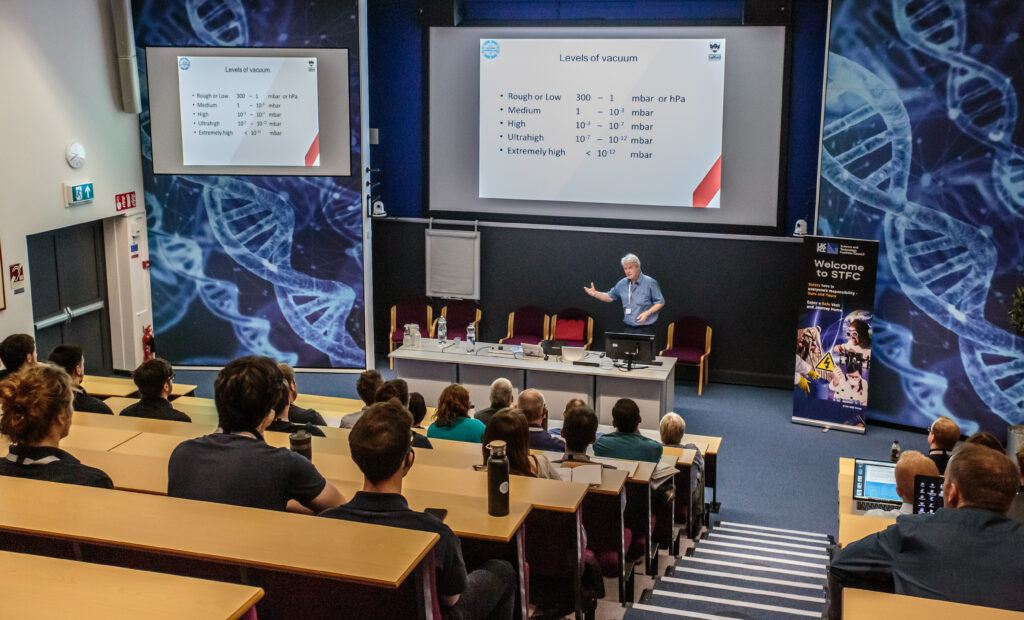
The subject of this course is how vacuum is produced and measured in a few typical devices whose operation reflects the application of the principles described in the VTC1 course. A representative selection of simple systems will be described and analysed.
Pumps: working principles and operating range of oil-sealed rotary, dry scroll, turbo-molecular, cryogenic and ion pumps.
Pressure gauges: classification and operating range. Working principles of Pirani, capacitance diaphragm and ionisation gauges.
Residual gas analysis. The quadrupole instrument.
Examples of systems at low and high vacuum.
Sources of further information.
Participants requiring an introduction to topics/devices not included in this list are invited to submit requests for the consideration of the organisers.
The course is primarily aimed those who need to use equipment operating at vacuum levels of 10-9 mbar or lower and is approached mainly from the physics aspects of vacuum science. Therefore, the course will emphasise the physical principles of equipment and processes.
There will be little mathematics or advanced physics used, so it will be suitable for people with an engineering or technical background. The topics to be covered will include:
a general introduction to vacuum and UHV in particular;
the measurement of total and partial pressures in UHV;
Outgassing and related phenomena;
processing; elements of system design and operation and quality assurance matters.
This course discusses the various uses and ever increasing requirements for leak detection, describing and defining what a leak is and the methods of detection, with practical demonstrations of finding leaks using a helium leak detector.
Discussions will include, modes of operation, such as Vacuum Mode vs Sniff Mode; Integral and local leak detection methods; description of various types of leaks that could be encountered and also various applications for Helium leak detection.
Finally, with time permitting, getting some audience participation to find leaks on some components.
This presentation gives an introduction to the basic requirements and properties of UHV chambers. The main focus will be the design and fabrication of chambers with regards to material choice and surface finish, together with a brief introduction to special-purpose solutions such as NEG coatings.
This short course will introduce participants to the principles of RGA as used to determine the partial pressures of gases in high ultrahigh vacuum (i.e. pressures below about 10-5 mbar.)
Concentrating on the most common form of instrument used for this technique — the small mass spectrometer — we will discuss the physics of ion sources, mass filters and detectors and how these affect the results obtained.
Finally, we will look at how a mass spectrum can be used to analyse the residual gases in the vacuum.
The course will be of interest to those science and engineering graduates or technicians who wish to gain an understand of this important technique. The level of physics involved will be elementary.
This practical course will concentrate on troubleshooting and pump maintenance. In addition, we will discuss potential errors and their causes.
The course will concentrate on general operating information for vacuum pumps, and the causes of faults when the desired ultimate pressure is not achieved, or is achieved too slowly.
Elements of cryopumping Intro to Cryosorption, cryo condensation and cryotrapping.
Kinetic energy theory and the effect of pumping speed.
Cryo consideration; sticking coefficient, transmission probability, saturated vapor pressure at cryogenic temperature Clausius-Clapeyron equation.
Cryopumps History of cryogenic vacuum.
Brief overview on the type of cryopumps.
Cryocooler Physics of cryocooling (thermodynamics).
Overview of Different cryocoolers (cold heads) and their operation principle.
Cryopumping basics Thermal load via convection, conduction and radiation.
Applications Cryocooling and cryopumping applications.
Event Type: Training
Event Title: Various Training Courses as described
Organised By: VS Training Committee
Fee: £60
Requires Registration: Yes (Use REGISTER NOW! link at top of this page)
Contact details: Vacuum Symposium UK Secretariat
E-mail: info@vacuum-uk.org