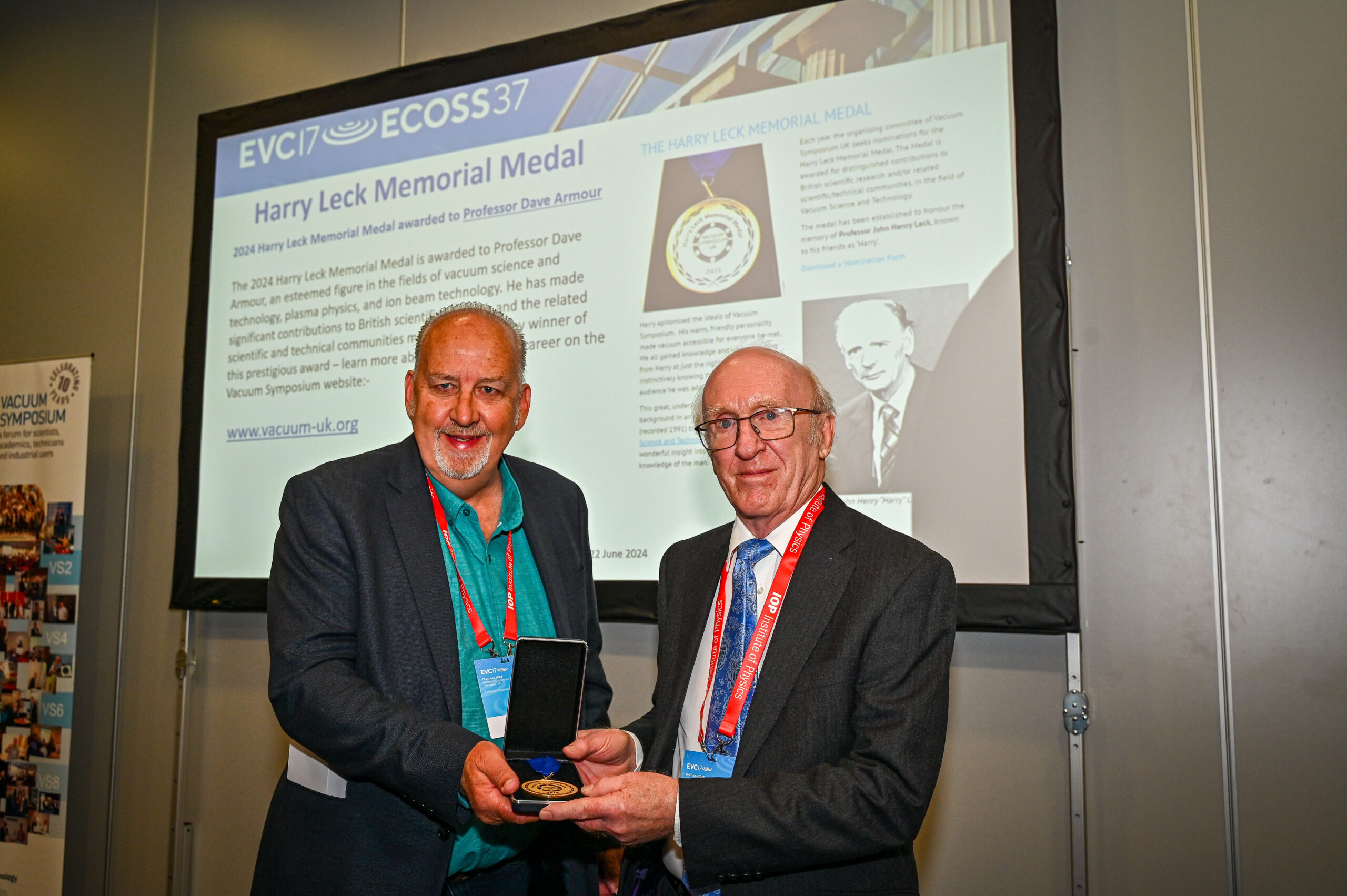
The winner of the 2024 Harry Leck Memorial Medal is Professor Dave Armour, University of Salford. Presentation of the Medal will be made during the RGA User Group meeting (MS-6) on Wednesday 19th June 2024 at the Harrogate Convention Centre, Cockcroft Room.

Educational Background and Early Career
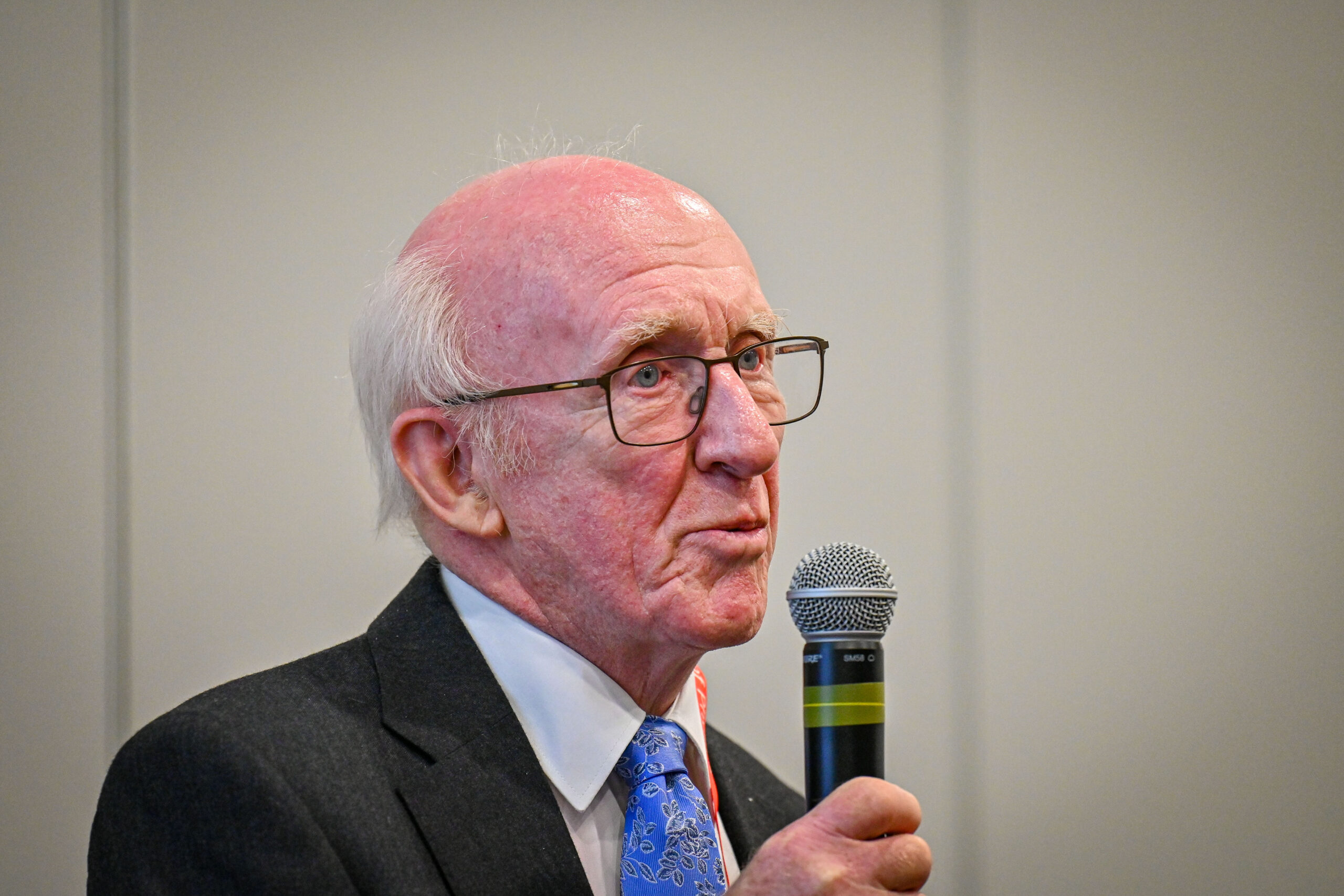
Dave Armour (pictured right in 1996) obtained his BEng and PhD degrees from the University of Liverpool, Department of Electronic and Electrical Engineering. His early research, which included Langmuir probe measurements in mercury arc discharges and microwave cavity studies of decaying plasmas, introduced him to the use of high and ultra-high vacuum (UHV) technology in scientific research. Following his doctoral studies, he was awarded an International Atomic Energy Research Fellowship, which led him to the University of Salford to join the Atomic Collisions in Solids group established by Professor George Carter.
Contributions to Ion Beam Technology
At Salford, Armour’s initial work focused on using low energy ion beams to analyse the composition and structure of solid surfaces. He developed a highly specialised UHV low energy accelerator system for low energy rare gas ion scattering (LEIS), a technique providing surface-specific information. This work involved extensive testing of materials such as dry powder lubricants to ensure the functionality of complex gear systems in UHV conditions. Armour’s pioneering efforts led to the development of over ten experimental ion beam and plasma machines at Salford over the next thirty years, including a medium energy ion scattering (MEIS) machine that contributed to establishing the National MEIS Facility in Daresbury.
Academic and Collaborative Achievements
During his nearly thirty-year tenure at Salford, Professor Armour supervised 28 PhD students and collaborated with visiting scientists from over ten countries. His prolific research output includes nearly 200 papers in international and national refereed journals. He was an invited speaker at numerous conferences, notably delivering the Plenary talk at the 17th International Ion Implantation Conference in Monterey, California, in 2008. His work in low energy ion-surface interactions also led to a fruitful collaboration with Applied Materials, resulting in the commercial production of a low energy implanter widely used in the semiconductor industry.
Industry Contributions and Later Career
In 1997, Armour joined Applied Materials as a Senior Physicist, where he contributed to a major ion beam project in Santa Cruz, California. Upon returning to the UK, he continued as a consultant for Applied Materials and other companies until his retirement in 2008. Armour’s industry impact is underscored by his involvement in the development of new ion implantation technologies, with over a billion dollars’ worth of machines sold and ten granted US patents to his name.
Professional Service and Recognition
Throughout his career, Armour served on various committees of the Institute of Physics, including the Atomic Collisions in Solids, Vacuum, and Atomic and Molecular Physics Committees. He also consulted for the Ministry of Defence and Vacuum Science Workshop Ltd and acted as a referee for multiple research councils and scientific journals.
Research Impact and Innovations
Professor Armour’s research spans numerous areas within vacuum and ion beam technologies, including:
- Plasma Afterglow
- Vacuum Science and Technology
- Low Energy Ion Scattering (LEIS)
- Thermal Desorption Mass Spectrometry
- Medium Energy Ion Scattering (MEIS)
- Ultra-low Energy Ion Implantation
- Ion Beam Deposition
- Secondary Ion Mass Spectrometry
- Bombardment Induced Light Emission
- Sputtering
- Radiation Damage
- Ion Plating
- Reactive Ion Etching
- Magnetron Sputtering
- Rutherford Backscattering
- Technologies of Ion Beam Formation and Transport
- Ion Beam Physics – Emittance and Space Charge
- Ion Source Plasmas
- Ion Beam Plasmas
- Liquid Metal Ion Sources
His contributions to ion implantation technology have been particularly impactful, with patents on various ion sources, implanter electrodes, beam monitoring and tuning methods, and spectrum analysers in ion implanters.
Legacy
Professor Dave Armour’s legacy in vacuum science and technology is profound, marked by his innovative research, extensive collaboration, and significant contributions to both academia and industry. His work has not only advanced scientific understanding but also led to practical applications that continue to benefit various high-tech industries.